1, the lead story
Hi, I’m Atishay.

I’m a founder in Bengaluru. I started ScaleWorks AI after a little over three years as a software engineer at Microsoft. Before that, I did a dual degree in computer science and physics at BITS Pilani.
My X bio says I’m applying breadth-first search to life, and that’s honestly how I’ve worked. Before going deep on one thing, I tried teaching, running student societies, research on health data and ageing, and cloud billing systems. Each one taught me something the next one needed.
I like meeting new people. Get me started on physics, market economics or how societies change over time, and I’ll happily lose track of time. I’m especially curious about how learning works, in brains and in machines.
The thread through all of it: when I see something disorganized, I can’t help giving it structure.
2
The story so far
From a computer centre to Goa, Halifax, Hyderabad and Bengaluru.
- Age 8-ish
A computer centre
My cousin ran the A2Z Computer Education Center, and I practically lived there. I installed Windows from DVDs, watched him repair machines, and started swapping RAM in assembled desktops myself.
I walked away believing anything in tech is learnable if you’re willing to get your hands dirty. I still believe it.
- Until 2017
Delhi Public School, Sonepat
I topped my school and was Head of the Student Executive Council.
After I graduated, I went back and taught at the same school for a couple of months. Standing at the front of a classroom you sat in a few months earlier is a quick lesson in how much teachers actually do.
- 2018 to 2023
BITS Pilani, Goa campus
A dual degree in computer science and physics. My relatives still don’t have a satisfying answer for what exactly I studied. Outside class, I spent most of my time building things for other students.
Second year
Secretary, Physics department
I started a department week to spread curiosity about physics through the stream, with talks and workshops that got juniors and seniors in the same room.
2020 to 2021
Vice President, E-Cell
I partnered with the alumni network to host some of the best events the E-Cell has run, and introduced Business Model Canvas, a first-of-its-kind competition where participants learned the framework first and then competed with it.
I was also a teaching assistant for a course on nonlinear dynamics and chaos. Good preparation for startups, it turns out.
-
A short stint at IIT Guwahati
I got in through a highly selective process and spent a short stint at IIT Guwahati.
- 2022
Halifax, Canada, for my thesis
I was selected for Mitacs Globalink, a fully funded international research programme, which took me to Dalhousie University in Halifax for six months.
In Prof. Andrew Rutenberg’s group, I used variational autoencoders to compress health-deficit data into a compact representation for predicting ageing and mortality.
It’s still the reason I nerd out about my own health markers.

A solo trip to Toronto, on a weekend away from the lab. - 2023
Nutanix, Bengaluru
A six-month internship building a rule-matching tool that made sense of huge volumes of messy logs from distributed systems. Making sense of mess, again.
- 2023 to 2026
Microsoft, Hyderabad then Bengaluru
I started in Hyderabad as a software engineer in Azure Data, on a mission-critical service that processes cloud-scale usage data in real time for billing. Later I worked on the orchestration layer for a self-healing data platform.
I moved to Bengaluru to be closer to more opportunities, and that’s where ScaleWorks started. Microsoft taught me how a giant actually works, and why it works that way.
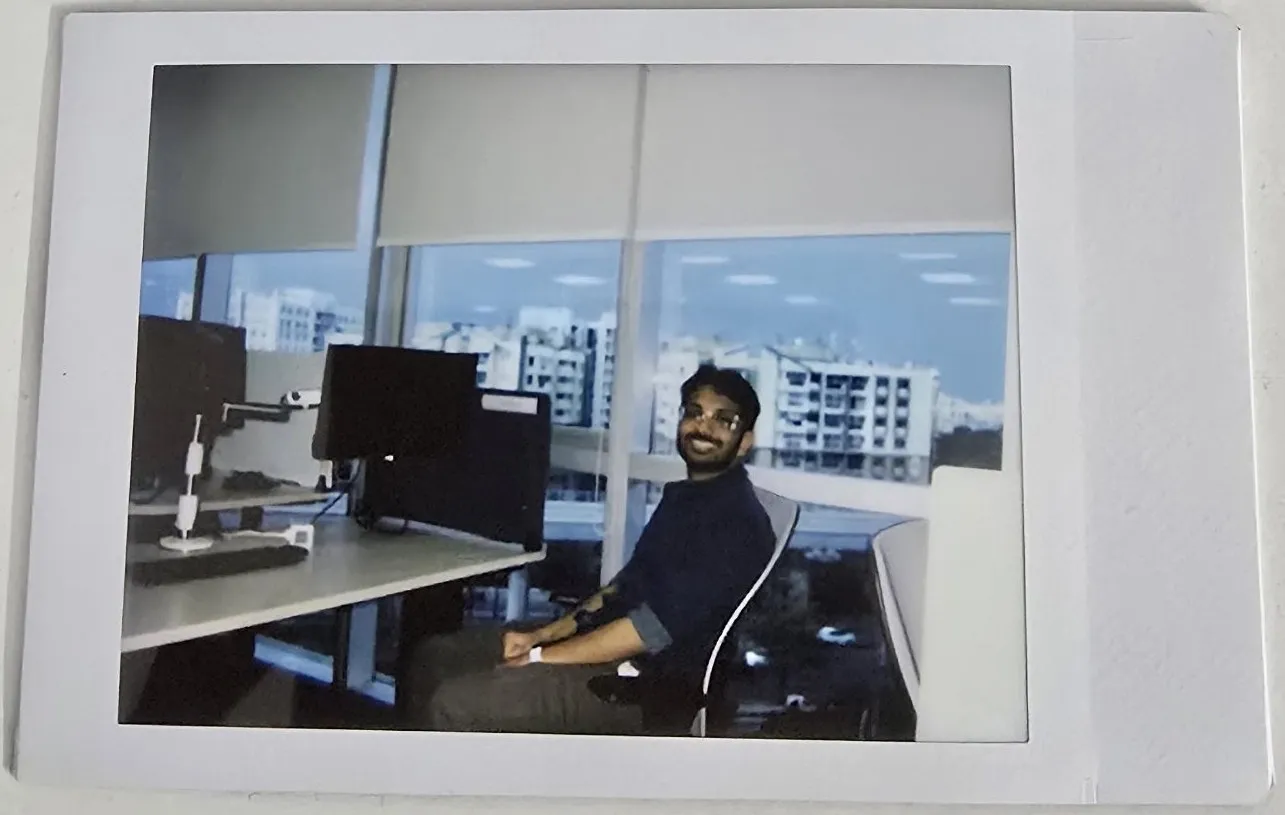
My last day there. - 2026
ScaleWorks, full time
I left Microsoft to give ScaleWorks all of my attention. A month later, Microsoft announced a voluntary exit offer that would have paid me roughly ₹15 lakh to leave. I wrote about that, and the news picked it up.
Somewhere in between, I also spent a few months at Linkrunner, an early-stage startup, to see how fast things move when decisions take seconds.
3
What I’m building
ScaleWorks AI is building an AI operating layer for big companies, staffed by AI Employees.
Large organizations rarely struggle because people aren’t working hard. They struggle in the gaps: a job nobody followed up on, a handoff that quietly stalled, a process that takes three days when it should take three hours. Nobody sees those gaps until they turn into a missed deadline or an unhappy customer.
We’re building the layer that finds those gaps and closes them. It works in three steps.
-
Step 1
See everything
The operating layer connects to the tools a company already uses and builds a live picture of every job, owner and handoff. Observability for operations, not just servers.
-
Step 2
Spot what’s slipping
It flags inefficiencies, bottlenecks and jobs with no clear owner or follow-through, before they become someone’s problem.
-
Step 3
Fix it with AI Employees
AI Employees step in to chase follow-ups, verify work, keep records straight and take repetitive tasks off people’s plates, with humans in the loop.
The goal: companies where no job falls through the cracks, and people spend their time on work only people can do.
- Co-founded with Arunabha Mukherjee
- Member of the OpenAI Partner Network
- Built in Bengaluru
4, explained
Two bets I’m making
I’m still learning, so treat these as hypotheses I’m testing at ScaleWorks rather than predictions.
Bet one: AI is the missing link for big companies
At Microsoft I saw why giants run on process. When your service decides what customers get billed, nothing is allowed to break overnight. At a startup I saw the opposite: features shipped in days and decisions took seconds. Each side pays for its strength.
The giant
Resilient, because process holds it together. The price is speed.
The startup
Fast, because nothing slows it down. The price is fragility.
The bet
AI fills the gaps process creates, so the giant speeds up without getting fragile.
Everyone chooses their poison. Both sides could use better optimization.
Bet two: evals are the real work
An AI agent can only work on its own if you can tell, reliably, when it got something right. I think eval engineering is going to be the skill. The teams that write the best evaluations will be the ones whose agents can be trusted to run without a human watching.
Where I first said this, on X5
From the feed
What I’ve been posting on LinkedIn and X.
Pinned, LinkedIn and X, 30 Oct 2026
I missed ₹15 lakh by quitting one month too early
A month after I quit Microsoft to build ScaleWorks, Microsoft announced a voluntary exit offer. Had I waited, I’d have walked out with roughly ₹15 lakh extra, for leaving a job I’d already decided to leave.
Does it sting? Oh yes. Do I regret leaving? Not for a second. Ask me in two years.
X, Aug 2026
My bet is eval engineering is going to be THE thing moving forward. It will all boil down to how well you’re able to write evals, so your agents can work autonomously.
AI, explained, part 3, LinkedIn, Aug 2025
Which AI model should I use? Navigating the map
Match the model to the task, check your context and speed needs, do the cost math, then test on your own data. Golden rule: start small, scale up only when you hit limits.
AI, explained, LinkedIn, Aug 2025
Reading OpenAI’s GPT-5 prompting guide
Different prompting techniques work better on different models, because each model is built differently.
AI, explained, part 2, LinkedIn, Aug 2025
Which AI model should I use? The map
Modality, open versus closed source, model size and capabilities: the four things that explain why there are so many models, and how they differ.
AI, explained, part 1, LinkedIn, Jul 2025
AI is everywhere. How does it actually work?
LLMs are, at heart, next-word predictors. The reason ChatGPT answers your question instead of just finishing your sentence is instruction tuning.
X, Dec 2024
Feelings make us want to do everything, but reality demands a check. If your to-do list has 20 tasks and you’ll only finish 10, don’t add more just because you “feel” like it. Commit to what’s practically possible.
X, Oct 2021
Feeling lighter on the head but heavy in the heart. Took a break from a three-year-long relationship with my goatee.
X, Sept 2021
Being a dual-degree student, I still don’t have that one convincing answer to the question relatives ask about what I’m studying. Anyone cracked it?
X, Sept 2021
Life is unfair. Those who watch YouTube gym videos all day hardly make any gains compared to those who just work out for an hour a day.
X, Jun 2021
Startup or business?
When I explain the difference between a startup and a business, I emphasise scale and innovation. Zomato looks like any food delivery service until you look at how differently it solves the same problem.
X, May 2021
In the language of reinforcement learning, old is when you exploit more and explore less.
X, May 2021
Touch typing today is a very useful but highly underrated skill.
X, Apr 2021
Fortune telling blinds us to opportunities. We often convince ourselves that we know what’s going to happen, often baselessly, and that limits our opportunities.